Understanding Text-to-Speech: How Written Language Becomes a Natural Voice
January 15, 2026
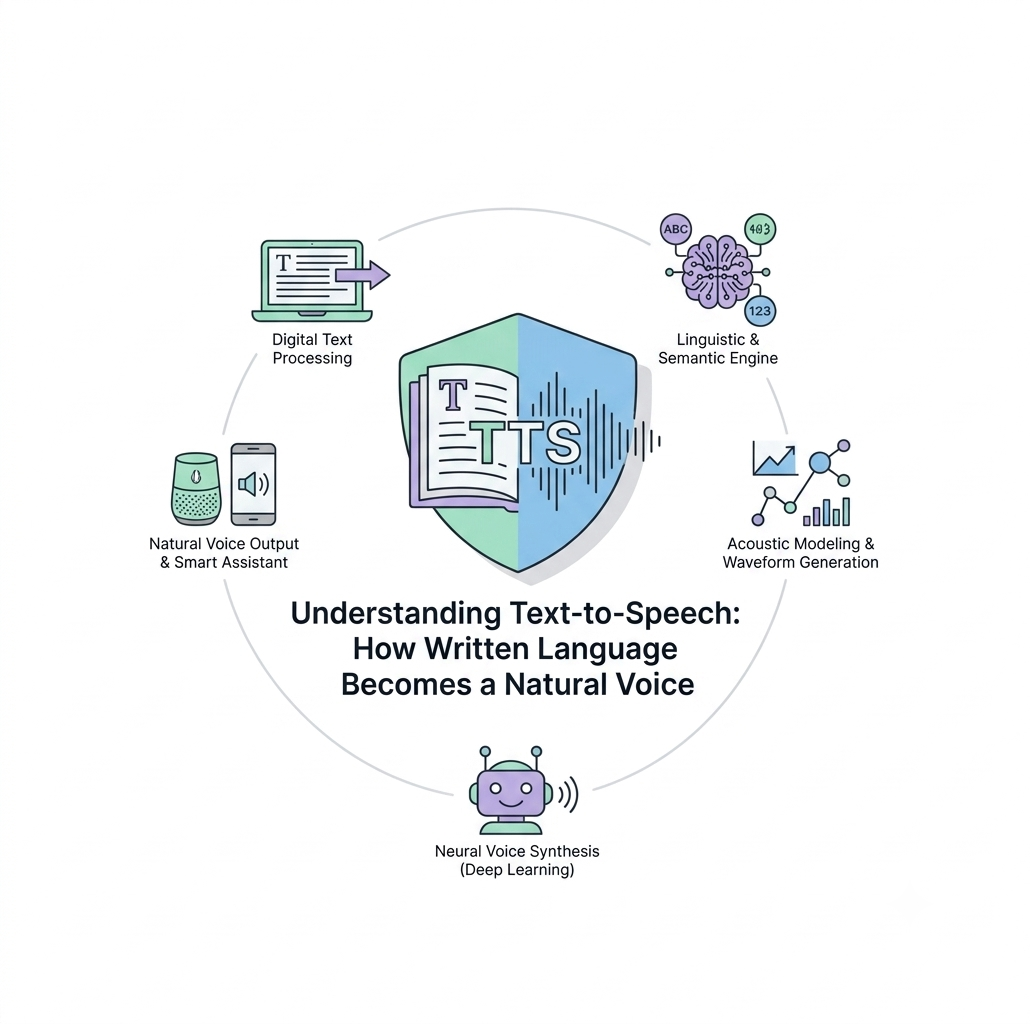
Table of Contents
Understanding Text-to-Speech: How Written Language Becomes a Natural Voice
Text-to-speech technology has quietly moved from being a novelty to becoming a core part of how modern digital products communicate. What once sounded robotic and awkward is now capable of producing speech that closely resembles human rhythm, tone, and pacing. This evolution didn’t happen overnight. It is the result of years of research in linguistics, machine learning, and signal processing coming together into systems that can understand written language and transform it into spoken sound.
Today, text-to-speech is used far beyond accessibility tools. It powers virtual assistants, narrates educational content, supports customer service automation, and enables creators to turn text into audio without recording a single word. To understand why it has become so effective, it helps to look under the hood and explore how modern TTS systems actually work.
From Characters to Sound: The Core TTS Pipeline
At a technical level, text-to-speech systems operate through a multi-stage pipeline. The process begins with text normalization. Raw text is rarely suitable for direct conversion into speech. Numbers, abbreviations, symbols, and punctuation must first be interpreted correctly. For example, “2025” might be read as “two thousand twenty-five” or “twenty twenty-five” depending on context. A good TTS engine resolves these ambiguities before moving forward.
Once the text is normalized, it passes through linguistic analysis. This stage involves breaking text into phonemes, the smallest units of sound in a language. English, for example, contains phonemes that don’t map cleanly to spelling, which is why words like “though” and “through” sound completely different despite similar letter patterns. Advanced systems rely on pronunciation models and contextual rules to generate accurate phoneme sequences.
Prosody modeling comes next. This is where speech starts to feel natural rather than mechanical. Prosody controls rhythm, intonation, stress, and pauses. Without it, speech sounds flat and unnatural. Modern systems analyze sentence structure and punctuation to decide where emphasis should fall and how pitch should vary over time.
Finally, the system generates audio. Earlier TTS technologies relied on concatenative synthesis, stitching together prerecorded voice fragments. While effective, this approach lacked flexibility. Today’s systems use neural speech synthesis, where deep learning models generate audio waveforms directly. This allows for smoother transitions, consistent voice quality, and more expressive output.
The Role of Neural Networks in Modern Speech Synthesis
Neural text-to-speech systems represent a major leap forward. Models such as Tacotron, FastSpeech, and diffusion-based vocoders learn the relationship between text and sound by training on massive datasets of recorded speech paired with transcripts. Instead of selecting audio clips, the model predicts how speech should sound based on learned patterns.
One of the biggest advantages of neural synthesis is scalability. A single model can generate speech for thousands of sentences it has never seen before while maintaining consistent tone and pronunciation. It can also adapt to different speaking styles, speeds, and emotional tones, depending on how it was trained.
Another technical improvement is latency reduction. Earlier neural systems were powerful but slow. Newer architectures optimize inference speed, making it possible to generate speech almost in real time. This is critical for applications like live narration, interactive tools, and dynamic video generation.
Why Text-to-Speech Quality Depends on Data, Not Just Algorithms
While algorithms matter, the quality of a TTS system depends heavily on training data. High-quality datasets include diverse sentence structures, emotional variation, and clean audio recordings. Poorly curated data leads to pronunciation errors, unnatural emphasis, or inconsistent pacing.
Language coverage also matters. Each language has unique phonetic rules, stress patterns, and intonation systems. Multilingual TTS requires separate modeling strategies or language-specific fine-tuning. Even within the same language, accents and dialects introduce additional complexity.
This is why modern TTS platforms focus not only on model architecture but also on data preprocessing and evaluation. Continuous testing with real-world text helps systems handle edge cases like technical terminology, brand names, or mixed-language sentences.
Practical Applications Beyond Accessibility
Text-to-speech is often associated with accessibility, and rightly so. Screen readers and audio narration are essential for users with visual impairments or reading difficulties. But technically advanced TTS has unlocked many other applications.
In education, TTS allows written materials to be converted into audio lessons instantly. Students can review content while commuting or exercising, and educators can update materials without rerecording lectures or using a screen capture to create visual learning resources. In enterprise environments, TTS supports internal documentation, compliance training, and onboarding materials.
Content creation has also changed. Blog posts, scripts, and social captions can be transformed into narrated videos or podcasts without microphones or studios. Tools that integrate TTS into design workflows, such as the AI text to speech feature from Adobe Express, make it easier for non-technical users to deploy speech in multimedia projects without understanding the underlying complexity.
Customer support systems increasingly rely on TTS to deliver consistent responses at scale. When paired with natural language understanding, TTS enables conversational interfaces that feel more responsive and human than traditional automated systems.
Voice Control, Emotion, and Customization
One of the most technically challenging aspects of TTS is emotional expression. Human speech carries subtle emotional cues through pitch, speed, and emphasis. Capturing this requires models that understand not just text, but intent.
Recent advancements allow TTS systems to adjust speaking style based on context. Informational content may sound neutral and steady, while storytelling benefits from dynamic pacing and expressive intonation. Some systems support parameter control, enabling developers to fine-tune pitch, speed, and emphasis programmatically.
Voice cloning and custom voices are another emerging area. By training on limited voice samples, models can replicate a specific vocal identity. This raises both creative opportunities and ethical questions, particularly around consent and misuse. Responsible platforms implement safeguards to prevent unauthorized voice replication.
Technical Challenges Still Being Solved
Despite impressive progress, text-to-speech is not a solved problem. Long-form narration can still reveal inconsistencies in pacing or emphasis. Handling highly technical language, code snippets, or domain-specific jargon remains difficult without specialized training data.
Another challenge is contextual understanding. While models can infer prosody from sentence structure, they don’t truly “understand” meaning in a human sense. This can lead to misemphasis in complex sentences or ambiguous phrasing.
Latency and computational cost also matter. High-quality neural synthesis requires significant processing power. Optimizing models to run efficiently on consumer hardware or in browsers remains an active area of research.
Integrating TTS Into Modern Digital Workflows
From a technical perspective, TTS is increasingly offered as an API-driven service. Developers can send text and receive audio streams in return, enabling integration into apps, websites, and content platforms. For non-developers, design-first tools abstract this complexity away, embedding TTS into visual workflows.
The key to successful integration is understanding where voice adds value rather than using it everywhere. Narration works best when it clarifies, guides, or enhances understanding. Overuse can feel distracting or unnecessary.
Teams that treat TTS as a complementary layer rather than a replacement for text tend to see better results. Combining readable text with optional audio respects different user preferences and contexts.
The Future of Text-to-Speech
Looking ahead, text-to-speech will continue to move closer to natural human communication. Improvements in emotional modeling, multilingual support, and real-time generation will expand its role across industries. As models become more efficient, high-quality speech synthesis will be accessible to more creators and organizations.
The most impactful use of TTS will not come from novelty, but from thoughtful application. When voice is used to reduce friction, increase clarity, and respect the listener’s time, it becomes an essential part of modern digital communication.
Text-to-speech is no longer just about converting words into sound. It is about translating ideas into experiences that people can hear, understand, and connect with.
Related Articles

Best Alternatives to Jasper.ai
Discover the top AI writing tools that compete with Jasper.ai in pricing, features, usability, and content quality.

Top 10 AI Tools for Brand Reputation Management
Discover the top 10 AI tools for brand reputation management in 2025, including Brandwatch, Mention, Reputology, and more. Learn how AI-powered sentiment analysis, predictive analytics, and real-time monitoring safeguard your online presence and boost trust.

Top 10 AI Tools for Grammar Checking
Discover the top 10 AI grammar checkers in 2025: Grammarly, ProWritingAid, QuillBot, LanguageTool, Ginger, Wordtune, Hemingway, Sapling, Trinka AI, and Writer.com. Enhance clarity, style, and professionalism in your writing.