10 Best AI Governance Tools for Businesses in 2026
Compare 10 AI governance tools by the work they help businesses do: inventory AI systems, assess risk, document decisions, and monitor deployed models. A consistent evaluation framework makes the shortlist easier to use.
October 17, 2026
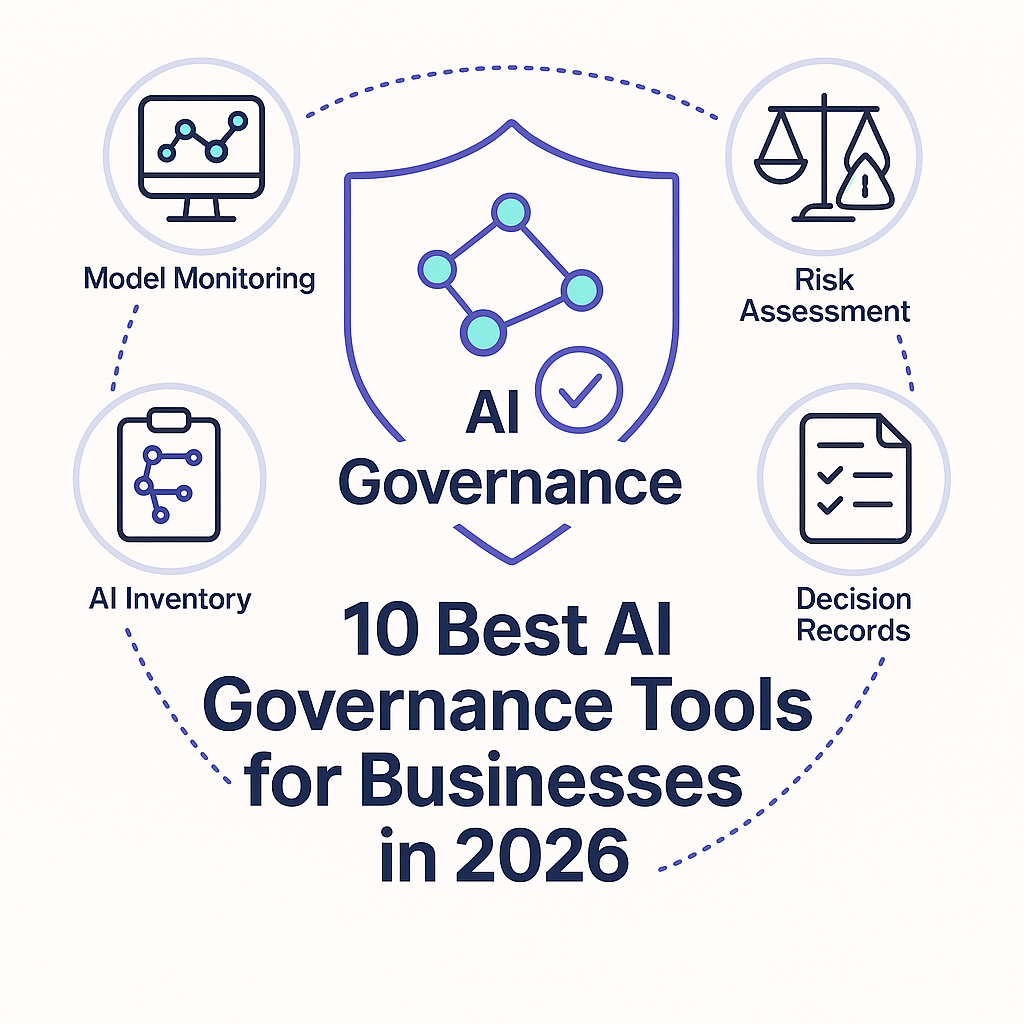
Table of Contents
10 Best AI Governance Tools for Businesses in 2026
Compare 10 AI governance tools by the work they help businesses do: inventory AI systems, assess risk, document decisions, and monitor deployed models. A consistent evaluation framework makes the shortlist easier to use.
Introduction
AI governance tools help businesses track where AI is used, identify who owns each system, assess risks, document approvals, and monitor what happens after deployment. The right tool depends on the work it must support: maintaining an AI inventory, reviewing proposed uses, checking model behavior, or producing evidence for internal and regulatory scrutiny.
Those jobs are related, but they are not interchangeable. A system that records an approval decision may do little to detect a model drifting in production; a monitoring tool may not capture why a use case was approved in the first place. This guide compares 10 tools by their strongest business AI governance use case, the evidence they help teams collect, and the limitations that matter when building an AI risk management workflow.
Key Findings
- OneTrust is the strongest starting point for businesses that want AI oversight tied to existing privacy and risk reviews.
- IBM watsonx.governance is a better fit when governance records must connect to model development, evaluation, and deployment.
- Credo AI is best suited to turning AI policies into repeatable assessments with documented evidence.
- Microsoft Purview AI Hub helps organizations investigate AI use and data risk within Microsoft environments, but it is not an enterprise-wide AI inventory.
- Assessment records do not replace live model monitoring, so teams must connect operational changes and incidents back to governance reviews.
10 Best AI Governance Tools for Businesses in 2026
OneTrust is the strongest starting point for businesses tying AI oversight to existing privacy and risk reviews; IBM watsonx.governance is a better fit for model-development teams, while Credo AI emphasizes policy-led assessments. This ranking weighs inventory and ownership, risk workflows, audit evidence, monitoring, integrations, deployment options, and implementation effort. It reflects best-fit use cases, not a universal winner.
1. OneTrust AI Governance — best for established privacy and risk workflows
Best for: Organizations that want AI reviews to sit alongside their existing privacy and risk processes.
OneTrust’s central advantage is its treatment of AI systems as governed business activities, not just technical models. Its AI inventory helps teams record what a system is used for, who owns it, and where it sits in the organization. Assessments then give privacy, legal, security, and business stakeholders a way to examine a proposed use before approval. That connection matters when an AI application handles personal data: a model record alone will not show who reviewed the data use or accepted the associated risk.
The practical distinction is between discovering an AI use case and making someone accountable for it. OneTrust is most compelling when teams can use existing review responsibilities to keep inventory entries and assessments current. Otherwise, an inventory can become a list of applications that nobody revisits.
Its trade-off is emphasis. OneTrust is better suited to documenting ownership, decisions, and risk treatment than to serving as a specialist tool for detecting changes in live model behavior. A business with many independently operated models should determine how operational signals reach its governance records. Choose OneTrust when the hard problem is coordinating oversight across departments; look more closely at IBM, ModelOp, or Fiddler if model operations or monitoring is the primary need.
2. IBM watsonx.governance — best for governing models across development and deployment
Best for: Teams that need governance records connected to the way models are built, evaluated, and operated.
IBM watsonx.governance focuses on the model lifecycle. It gives organizations a way to document model information, examine evaluation results, and maintain oversight as models move toward deployment and ongoing use. That makes it distinct from an assessment system concerned mainly with whether a proposed business use should proceed. Technical teams need to know what changed in a model and how it behaved; risk teams need enough context to interpret those changes.
Its strongest use case is a portfolio in which data scientists, model owners, and reviewers must work from related evidence. For example, an approval decision has limited value if it cannot be connected to the model version and evaluation that informed it. Buyers should examine that link closely, especially when models are developed or hosted outside IBM’s ecosystem.
The limitation is that lifecycle governance does not automatically create a complete inventory of employees’ AI use or replace organization-wide policy intake. Implementation also depends on where the organization’s model records and workflows already live. Choose IBM when the governance gap starts inside model development and deployment. If the immediate challenge is collecting proposed AI uses from business units before technical work begins, OneTrust or Credo AI may be the more natural starting point.
3. Credo AI — best for policy-led assessments and evidence workflows
Best for: Organizations that need to turn AI policies into repeatable reviews with documented outcomes.
Credo AI approaches governance through assessments, controls, and evidence. Its appeal is the ability to organize review questions around the requirements a business has chosen to apply, then track the responses and supporting documentation. This is useful when a risk committee must ask the same core questions across very different systems: a customer-service assistant, a hiring application, and an internally developed prediction model should not receive identical scrutiny, but each needs a recorded rationale for its decision.
Credo AI belongs high on this list because it addresses the work between writing a policy and showing that anyone followed it. Assigning responsibilities and collecting evidence can make a review reproducible rather than dependent on a particular meeting or reviewer. The quality of the result still depends on the organization defining meaningful controls and supplying reliable information about each AI use.
Its limitation is that assessment evidence is not the same thing as live performance monitoring. Teams should establish how incidents, model changes, and operational test results will feed back into a completed review. Choose Credo AI if policy interpretation and defensible review records are the bottleneck. A team whose main concern is detecting drift or explaining individual model outputs should examine a monitoring specialist instead.
4. Microsoft Purview AI Hub — best for visibility into AI use across Microsoft environments
Best for: Organizations that already manage information protection through Microsoft and need to investigate AI-related activity there.
Microsoft Purview AI Hub is oriented toward understanding AI use and associated data risk within Microsoft environments. Its differentiator is proximity to Purview’s information-governance controls: the question is not only which AI application is in use? but also what organizational data might people share with it? That perspective is particularly relevant for security and compliance teams concerned about sensitive documents appearing in prompts or other AI interactions.
This is a different starting point from a model registry. A company might have few internally developed models yet substantial employee use of AI assistants. Visibility into that activity can expose a governance problem that a development-focused inventory would miss. It can also help teams prioritize controls around data handling rather than treating every AI use as the same type of risk.
The boundary matters. Visibility into activity in a Microsoft environment should not be mistaken for an enterprise-wide inventory of every model, vendor, and business decision. Buyers should map where employees use AI outside the systems Purview can observe and decide how those uses will be recorded and reviewed. Choose Purview AI Hub when Microsoft data governance is the operational center of the problem; use a broader assessment platform when the central task is approving and documenting AI use cases across the business.
5. Collibra AI Governance — best for connecting AI oversight to data governance
Best for: Organizations whose AI risks are closely tied to data ownership, definitions, and permitted use.
Collibra’s advantage is the relationship between an AI system and the data it relies on. An AI inventory is more useful when reviewers can also identify the relevant datasets, responsible data owners, and business meaning of the information involved. That connection helps answer questions a standalone model record may leave open: Is this customer field approved for the proposed use? Who can explain its definition? What changes if an upstream dataset changes?
Collibra AI Governance fits businesses that already treat data as a governed asset. Bringing AI oversight into that context can reduce the gap between a model owner’s description of an application and a data steward’s understanding of its inputs. It also makes data-governance participation part of the review rather than a late-stage consultation.
The limitation is equally important: data context is only one part of AI risk. A well-documented dataset does not establish that a model behaves acceptably after deployment, or that a generative system produces appropriate outputs. Buyers should identify which evaluation and monitoring tools will provide that evidence, and how it will be attached to governance records. Choose Collibra when existing data-governance work is the foundation to build on. If that foundation is thin, establishing owners and reliable metadata will be a substantial part of implementation.
6. ModelOp — best for operational controls across an enterprise model portfolio
Best for: Enterprises that need consistent model oversight across teams and technologies.
ModelOp concentrates on operational governance: keeping track of models as managed assets and establishing controls around their movement through the lifecycle. That focus is useful when models have different owners, development methods, and deployment destinations. A central policy may say every model needs review, but the operational question is how to make that requirement apply when one team uses a managed platform and another runs its own pipeline.
ModelOp’s differentiator is this portfolio-level perspective. It is a stronger candidate when the organization wants governance processes to connect with model operations rather than remain separate paperwork. Buyers should examine how model registration, review responsibilities, and monitoring information would work across their actual environments. A governance process cannot enforce a checkpoint on a model it does not know exists.
This operational emphasis also defines the trade-off. ModelOp is less directly aimed at discovering informal employee use of AI assistants or managing privacy assessments for every proposed business application. Those uses may require another intake process. Choose ModelOp when the central challenge is applying controls consistently to a distributed model estate. If the organization has few internally managed models but many departments adopting third-party AI applications, a broader business-use inventory should come first.
7. Holistic AI — best for structured AI risk assessments and oversight
Best for: Risk and compliance teams that need a consistent way to examine AI systems across business units.
Holistic AI is oriented toward identifying, assessing, and managing AI risk. Its value lies in giving reviewers a structured way to consider an application’s purpose, potential harms, and required oversight, rather than relying on an unstructured description from its owner. That matters when an organization must compare unlike systems: the concerns raised by an automated decision affecting a person differ from those raised by an internal writing assistant.
A structured assessment can make those differences visible without pretending every system needs the same controls. Holistic AI is therefore a candidate for organizations seeking a common risk language across legal, compliance, technical, and business teams. The implementation question is how to make that language operational. Reviewers need clear ownership, criteria for escalating findings, and a way to revisit assessments when an AI system’s use changes.
Its limitation is that a completed risk assessment does not, by itself, prove that a live system continues to behave as expected. Organizations must decide where testing results, incidents, and changes in use will be captured. Choose Holistic AI when inconsistent risk evaluation is the immediate problem. If an existing assessment process works but model telemetry is missing, Fiddler or another monitoring-focused product addresses a different and more pressing gap.
8. DataRobot AI Governance — best for teams already managing models in DataRobot
Best for: Organizations whose model-development work is centered on DataRobot.
DataRobot’s governance appeal follows from proximity to the model lifecycle already managed in its platform. For teams building and operating models there, governance information is more useful when it can be considered alongside the model artifacts and operational work that produced it. Reviewers can ask concrete questions about a model’s purpose, ownership, evaluation, and continued use instead of trying to reconstruct that history from disconnected documents.
This is an ecosystem-fit recommendation, not a claim that one platform should hold every AI record. DataRobot makes the most sense when a meaningful share of the organization’s models already passes through it. In that situation, connecting governance to established development practices can be more workable than introducing an entirely separate process that model teams rarely update.
The limitation appears when AI activity extends well beyond that environment. Third-party applications, employee use of generative AI, and models developed elsewhere still need an owner and a review path. Buyers should determine whether their desired inventory covers those uses and how evidence from other systems would enter it. Choose DataRobot when improving oversight of DataRobot-managed models is the main objective. For a mixed enterprise estate, compare it with a portfolio-oriented option such as ModelOp.
9. Fiddler AI — best for post-deployment model monitoring and explainability
Best for: Teams that already deploy models and need to investigate how those models behave in operation.
Fiddler AI belongs on an AI governance tools list because oversight does not end with approval. Its emphasis is observability: monitoring model behavior and helping technical teams examine outputs when something looks wrong. Explainability adds another line of inquiry by helping reviewers investigate factors associated with a prediction. That is materially different from a questionnaire asking a model owner what they expect the system to do.
The operational distinction matters. A risk assessment can record an intended use and a set of safeguards; monitoring can produce evidence about what happens after deployment. For a customer-facing prediction system, a change in input data or output patterns may call for investigation even if the original approval remains documented. Fiddler is most useful when a team has defined who will respond to such signals and how findings become incidents or review updates.
Its limitation is scope. Monitoring a deployed model does not establish who approved its use, whether its data use was authorized, or which business policy applies. Implementation also requires teams to connect the models and data flows they want to observe. Choose Fiddler when post-deployment behavior is the missing piece; pair it with an inventory and decision workflow when accountability before deployment is also required.
10. Monitaur — best for documented model review and audit workflows
Best for: Organizations that need a clear record of model oversight decisions and the evidence behind them.
Monitaur focuses on the governance work surrounding models: documenting information about a model, coordinating review, and preserving a record that others can examine later. Its strongest fit is a business where the question “Who approved this model, based on what evidence?” must have an answer more precise than an email thread. A structured review record can show the reasoning and responsibilities behind a decision, not merely that a document was uploaded.
That emphasis makes Monitaur distinct from a monitoring-first product. An alert about changed model behavior is useful, but an auditor or internal reviewer also needs to see what was expected, what checks were required, and how exceptions were handled. Monitaur is a candidate when that decision trail is the gap in an otherwise functioning model process.
The trade-off is that documentation depends on timely input from model owners and reviewers. An orderly record can still be incomplete if model changes and operational findings never reach it. Buyers should establish how those updates will enter the workflow and who is responsible for reopening a review. Choose Monitaur for disciplined model-review evidence; choose a monitoring specialist if the immediate problem is detecting changes in live performance.
Quick Comparison
| Tool | Strongest use case | Notable strength | Key limitation | Best-fit organization |
|---|---|---|---|---|
| OneTrust AI Governance | Privacy-linked AI oversight | AI inventory and assessments | Not a specialist live-model monitor | Businesses with established privacy and risk reviews |
| IBM watsonx.governance | Model lifecycle governance | Connects oversight to evaluation and deployment | Does not cover all informal AI use by itself | Model-development teams |
| Credo AI | Policy-led reviews | Structured assessments and evidence | Needs operational findings from elsewhere | Organizations formalizing AI policy |
| Microsoft Purview AI Hub | Microsoft-environment AI visibility | Connects AI activity to data-risk concerns | Limited as an enterprise-wide model inventory | Microsoft-centered security teams |
| Collibra AI Governance | AI and data governance | Links AI oversight to data ownership | Data context does not replace model monitoring | Data-governance-led organizations |
| ModelOp | Enterprise model operations | Portfolio-level operational controls | Less focused on informal AI application use | Enterprises with distributed models |
| Holistic AI | Structured risk assessment | Consistent approach to evaluating different AI uses | Assessments need follow-up evidence | Cross-functional risk teams |
| DataRobot AI Governance | DataRobot model oversight | Governance close to model work | Other AI uses need a review path | DataRobot-centered model teams |
| Fiddler AI | Post-deployment oversight | Monitoring and explainability | Does not replace approval records | Teams operating live models |
| Monitaur | Model review records | Documented decisions and evidence | Relies on timely owner updates | Organizations formalizing model reviews |
How to Choose the Right AI Governance Platform
Choose an AI governance platform by identifying which AI systems your business must oversee, who makes decisions about them, and what evidence those decisions require. Then test the software against an actual workflow: can your team record a system, review its risks, retain an approval, and detect changes after deployment?
1. Assign ownership. In a smaller business, a privacy or risk lead may coordinate reviews with system owners. A larger organization may need separate reviewers and clear handoffs among legal, security, and model-development teams. Check that the workflow reflects those responsibilities.
2. Test the inventory. Ask how staff will record internally developed models, third-party AI tools, and employee use that has not yet entered an approval process. An inventory nobody maintains will quickly lose value.
3. Check the working environment. Identify where AI systems are built or procured, where review evidence already lives, and any deployment or data-handling requirements. Ask the vendor to demonstrate the relevant connections rather than assuming an advertised integration covers your workflow.
4. Run a representative review. Use one real AI use case to assess setup effort, evidence capture, approval handoffs, and how the team will monitor changes after launch.
A business extending established privacy reviews might choose OneTrust. A company whose main governance work sits with model-development teams might choose IBM watsonx.governance instead. The better choice is the one its owners can keep current.
How to Verify Framework and Certification Claims
A tool’s reference to the NIST AI Risk Management Framework or the EU AI Act does not establish regulatory compliance. Verify which provisions the tool maps, whether it records evidence that controls actually operate, and who reviews exceptions. A vendor’s certification also does not certify your organization’s AI systems.
1. Inspect the mapping. Ask for the specific framework functions or legal requirements covered, the version used, and any exclusions. The NIST framework is guidance; an EU AI Act mapping is a way to organize work against legal obligations, not a compliance determination.
2. Trace a control to evidence. For one AI system, follow a requirement through its assigned owner, assessment, approval, supporting records, and later review. A checked box shows that someone answered a question; AI auditing requires evidence of what was done and when.
3. Test exceptions. Ask how overdue reviews, rejected assessments, and accepted risks are recorded, escalated, and revisited. A framework dashboard can look complete while unresolved exceptions sit outside the workflow.
4. Check certification scope. Obtain the certificate or audit statement and confirm the issuing body, covered legal entity, services, standard, and validity dates. Establish whether it covers the vendor’s management system, a product, or a particular customer deployment; those are different claims.
5. Treat analyst coverage as context. Gartner coverage can inform a shortlist, not replace a current product evaluation. Before citing a specific report, confirm that it exists and check its date, scope, and inclusion criteria.
Conclusion
The best AI governance platform is the one that exposes your most important AI risks and gives the right people a practical way to act on them. A detailed AI model inventory matters little if systems go unrecorded; extensive assessments matter little if approvals have no clear owner. Narrow the list to tools suited to your main use case, then run one real AI system through each candidate: register it, assign an owner, review its risks, record a decision, and check what happens when the system changes. Confirm that the workflow fits the systems and teams you already use, and inspect the evidence behind any framework or certification claim. Choose the tool that keeps those records usable after the initial review, not simply the one with the longest feature list.
Frequently Asked Questions
What are the top AI governance tools in 2026?
The 10 AI governance tools in this guide are OneTrust AI Governance, IBM watsonx.governance, Credo AI, Microsoft Purview AI Hub, Collibra AI Governance, ModelOp, Holistic AI, DataRobot AI Governance, Fiddler AI, and Monitaur. Each is included for a distinct business use case, so the first entry is not automatically the best fit for every organization.
Do AI governance tools automatically make a business compliant with the EU AI Act?
No. AI governance tools can help document systems, assign responsibilities, and collect evidence, but businesses must determine which EU AI Act obligations apply and carry them out. Check a vendor’s support for the specific requirements relevant to your systems rather than relying on a broad compliance claim.
What should an AI model inventory include?
An AI model inventory should identify each system or model, its purpose, owner, deployment status, underlying providers, and the data or processes it affects. It should also link to risk assessments and review decisions. Keeping those records current helps teams track changes and identify systems that need attention.
Are there open-source AI governance tools businesses can use?
Yes. Open-source components can help with model documentation, evaluation, and monitoring. They may not provide a complete organization-wide governance workflow on their own, though. Assess how any combination of tools handles ownership, approvals, evidence retention, and integration with existing systems before relying on it for business AI governance.
Is AI monitoring the same as AI governance?
No. AI monitoring tracks behavior after deployment, such as performance changes or signals that need investigation. AI governance has a broader scope: it establishes ownership and policies, assesses risks, documents decisions, and defines review and escalation processes throughout the AI lifecycle. Monitoring can provide evidence for those processes, but it does not replace them.
Does a vendor’s AI governance certification cover a customer’s AI systems?
Not necessarily. A certification applies to a defined holder and scope, which may cover the vendor’s processes rather than a customer’s AI systems. Ask what was assessed, who assessed it, and when. Then identify the documentation and evidence your organization must produce for its own systems.
Related Articles

Best Alternatives to Jasper.ai
Discover the top AI writing tools that compete with Jasper.ai in pricing, features, usability, and content quality.

Top 10 AI Tools for Brand Reputation Management
Discover the top 10 AI tools for brand reputation management in 2025, including Brandwatch, Mention, Reputology, and more. Learn how AI-powered sentiment analysis, predictive analytics, and real-time monitoring safeguard your online presence and boost trust.

Top 10 AI Tools for Grammar Checking
Discover the top 10 AI grammar checkers in 2025: Grammarly, ProWritingAid, QuillBot, LanguageTool, Ginger, Wordtune, Hemingway, Sapling, Trinka AI, and Writer.com. Enhance clarity, style, and professionalism in your writing.