What Is an AI Data Center? How It Works and Why It Matters
An AI data center brings together specialized computing, networking, storage, power, and cooling to train and run AI models. Here’s how the systems work together—and why their growing footprint matters.
October 17, 2026
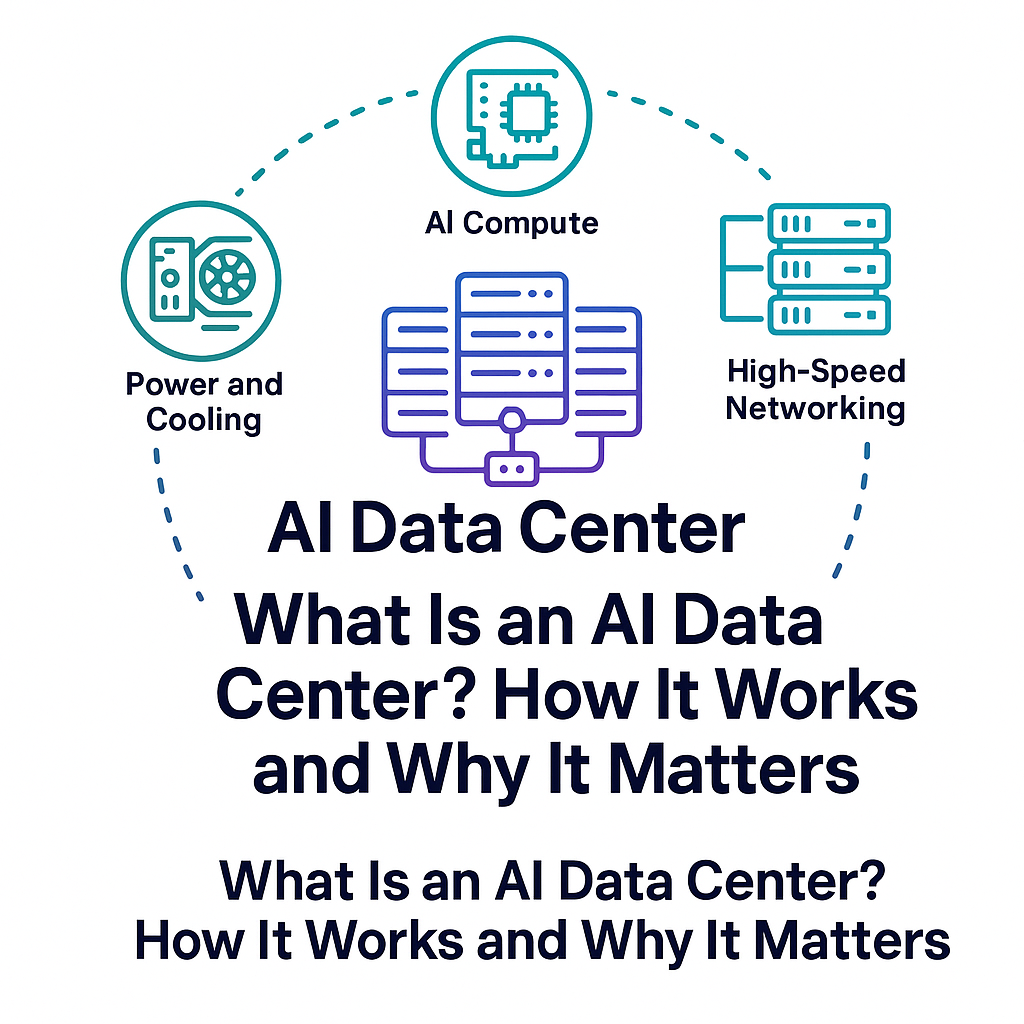
Table of Contents
What Is an AI Data Center? How It Works and Why It Matters
An AI data center brings together specialized computing, networking, storage, power, and cooling to train and run AI models. Here’s how the systems work together—and why their growing footprint matters.
Introduction
An AI data center is a facility built to run the computing workloads behind artificial intelligence. It brings together GPUs and other AI accelerators, fast networking, data storage, reliable power, and cooling. These systems support both training models on large datasets and inference—using a trained model to generate an answer or prediction.
The distinction from a conventional data center is not simply the presence of GPUs. Training a large language model can require many processors to work on the same job and exchange data quickly; if the network cannot keep up, those processors spend time waiting. Packing them together also concentrates heat and increases demands on power and cooling. Not every AI application needs that kind of facility, but understanding those demands explains how AI data centers work and why their effects extend beyond the servers inside them.
Key Findings
- Evaluate an AI data center by whether its computing, networking, storage, power, and cooling match the intended workload.
- Model training relies on fast communication among accelerators; slow networking can leave processors idle.
- Training and inference can require different balances of computing capacity, network performance, and response speed.
- Organizations can access AI computing capacity through their own facilities, cloud resources, or colocation facilities.
- AI data centers can strain local electricity grids and water supplies, making community impacts important to assess.
What Is an AI Data Center, and What Is Its Purpose?
The purpose of an AI data center is to provide the concentrated computing capacity needed to develop and run AI systems, including large language models. Its infrastructure connects servers containing GPUs or other AI accelerators with fast networking and data storage, supported by power and cooling systems. Unlike a traditional data center built primarily around general-purpose CPU workloads, it is designed for jobs that spread computation across many accelerators. That distinction matters most during model training, when those processors must exchange information quickly; serving a trained model to users, called inference, may need a different balance of computing capacity, network performance, and response speed.
How Does an AI Data Center Work?
An AI data center moves data from storage to computing hardware, where accelerators train a model or use an existing model to answer requests. The workflow has three stages: (1) CPUs prepare and feed data to GPUs or other accelerators; (2) during training, parallel computing splits calculations across accelerators, which exchange updates over high-performance networking; and (3) the system saves the trained model so it can process new inputs during inference. Training depends heavily on communication between machines: if data or updates arrive too slowly, accelerators can sit idle even when they have work assigned. Power delivery and cooling keep the hardware operating throughout both training and inference.
Why Do AI Data Centers Matter for Energy, Water, and Communities?
AI data centers can draw substantial electricity, putting pressure on local grids, while their cooling systems may draw on local water supplies. Their environmental impact depends not just on how much power they use, but on how that power is generated, how efficiently equipment runs, and how heat is removed. Liquid cooling, for example, does not by itself tell you how much water a facility consumes: the answer depends on how the cooling system rejects heat. For nearby communities, the practical questions are whether the grid and water supply can support the site, how noise and land use will be managed, and what the permitting process allows residents to scrutinize.
How Do Organizations Access AI Data Center Capacity?
Organizations can run AI workloads in a facility they operate, use cloud computing resources, or put their own servers in a colocation facility. Cloud providers manage the underlying facilities and make computing resources available remotely; colocation providers supply the space, power, and cooling while the organization manages its equipment. Building or operating a facility gives an organization the most direct control over its hardware and operations, but also leaves it responsible for those operations. For AI workload deployment, the practical choice depends on where data must reside, whether specific hardware is required, how quickly capacity is needed, and who can manage the systems.
Conclusion
An AI data center is a coordinated system for training models and serving inference requests, not simply a room filled with GPUs. Processors, networking and storage have to work together, while power and cooling determine whether the system can operate reliably. That distinction matters beyond the facility: a faster chip alone cannot solve a networking bottleneck, and a technically capable site may still strain local electricity or water resources. When evaluating AI computing facilities, ask whether the full AI model infrastructure matches the intended workload and what demands its operation places on the surrounding community.
Frequently Asked Questions
Are all data centers AI data centers?
No. Many data centers primarily run websites, databases, and business applications. An AI data center is designed or adapted to handle demanding AI workloads, often with specialized processors, networking, power, and cooling. A single facility can support both AI and general-purpose computing.
Do AI data centers only train models?
No. AI data centers can support both training and inference. Training develops a model through repeated computations on data; inference uses a trained model to respond to new inputs. A facility may handle either or both, with its hardware arranged to suit the workload.
Why are people against data centers being built?
Some people oppose proposed data centers because they worry about local electricity demand, water use, equipment noise, or changes to land use. Concerns can also grow when residents lack clear information or a meaningful role in permitting decisions. Which issues matter most depends on the site and the facility’s design.
Why does the United States have so many data centers?
The United States has substantial demand for cloud and enterprise computing, extensive network connections, and many existing facilities. Operators choose specific locations based on factors such as electricity availability, connectivity, suitable land, climate, and permitting conditions. Those conditions differ considerably across regions.
What is the downside of having a data center nearby?
A nearby data center may increase local electricity demand, use water if its cooling system requires it, produce equipment noise, or affect traffic and land use during construction. The actual effects depend on the facility’s design, local infrastructure, and how construction and operations are managed.
Does every AI data center use liquid cooling?
No. Some AI data centers use air cooling, some use liquid cooling, and others combine the two. The choice depends on factors such as how much heat the servers produce, how densely they are installed, the equipment’s design, and the facility’s climate and layout.
Related Articles

Best Alternatives to Jasper.ai
Discover the top AI writing tools that compete with Jasper.ai in pricing, features, usability, and content quality.

Top 10 AI Tools for Brand Reputation Management
Discover the top 10 AI tools for brand reputation management in 2025, including Brandwatch, Mention, Reputology, and more. Learn how AI-powered sentiment analysis, predictive analytics, and real-time monitoring safeguard your online presence and boost trust.

Top 10 AI Tools for Grammar Checking
Discover the top 10 AI grammar checkers in 2025: Grammarly, ProWritingAid, QuillBot, LanguageTool, Ginger, Wordtune, Hemingway, Sapling, Trinka AI, and Writer.com. Enhance clarity, style, and professionalism in your writing.