What Is the AI Bubble? Is Artificial Intelligence Overhyped?
An AI bubble would mean expectations for artificial intelligence have outrun what the technology can deliver. Here’s how to separate speculative enthusiasm from genuine progress.
October 17, 2026
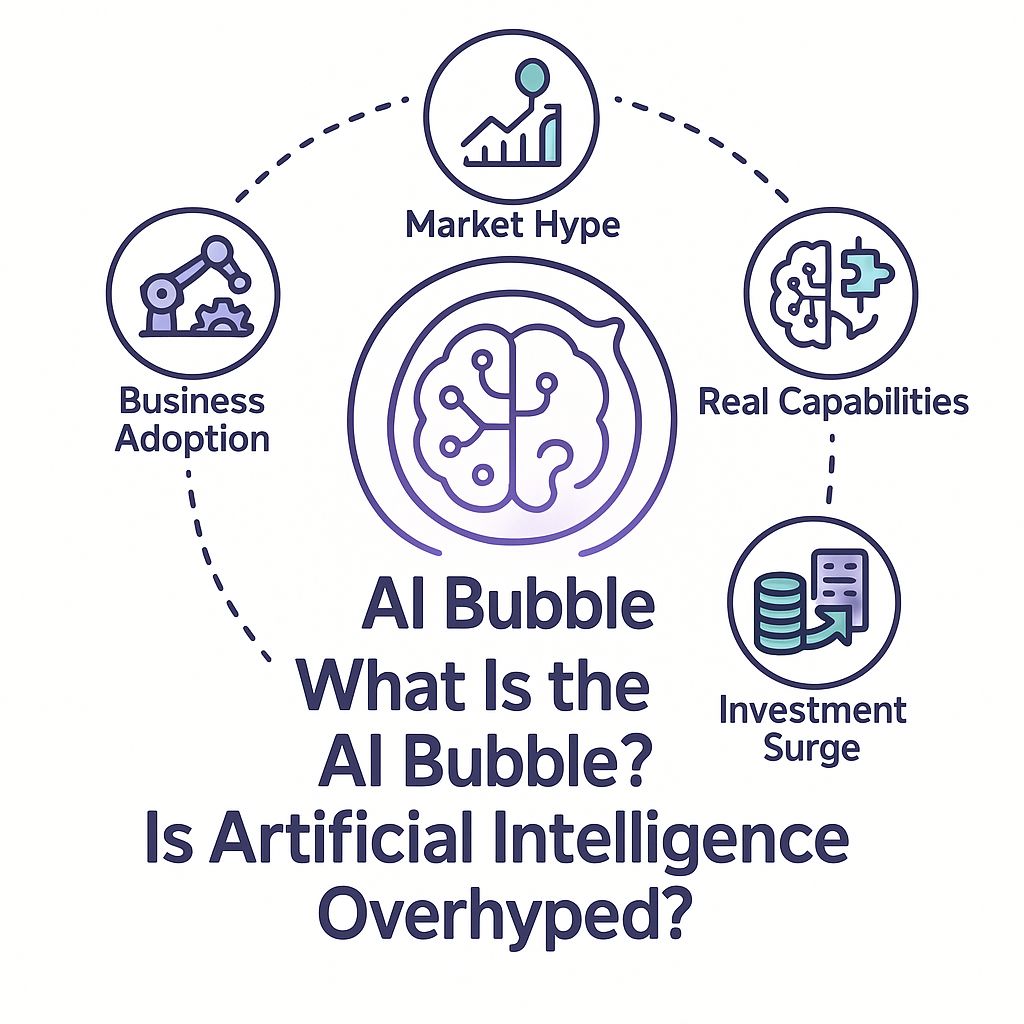
Table of Contents
What Is the AI Bubble? Is Artificial Intelligence Overhyped?
An AI bubble would mean expectations for artificial intelligence have outrun what the technology can deliver. Here’s how to separate speculative enthusiasm from genuine progress.
Introduction
AI works. Expectations may outrun adoption.
Key Findings
- Judge AI bubble risk by sustained use and measurable outcomes, not announcements or experiments alone.
- Useful AI and speculative technology valuations can exist at the same time.
- An impressive pilot is weaker evidence than AI use that becomes part of a routine workflow.
- An AI market downturn could hurt investors and startups without making established uses of the technology useless.
- The dot-com precedent cannot predict whether an AI downturn will happen or how widely it would spread.
What Is the AI Bubble, and How Can You Tell Whether It Exists?
An AI bubble would exist if expectations for future AI earnings pushed technology valuations beyond what businesses could plausibly deliver. To judge the risk, look beyond announcements of new models, startup launches, and data-center expansion: are organizations using AI repeatedly in real work, and are those uses generating durable revenue or measurable improvements? A pilot that impresses employees but never becomes part of a routine workflow is weaker evidence than sustained use, even if the underlying model performs well. The distinction matters because an AI investment bubble does not require artificial intelligence to fail; useful technology and speculative valuations can exist at the same time.
What Would an AI Bubble Burst Mean?
If an AI bubble burst, falling technology valuations could leave investors with losses, force some AI startups to shut down, and slow hiring and infrastructure expansion. The effects would depend on which businesses rely on continued investor backing: a company using AI to handle a useful, established task might keep using it even if its developer struggles. That distinction matters in comparisons with the dot-com bubble: a market downturn can wipe out companies without making the underlying technology useless. But the dot-com precedent cannot tell us whether an AI downturn will happen, when it might occur, or how widely the disruption would spread.
Conclusion
The AI bubble debate is about whether expectations are running ahead of results, not whether artificial intelligence has value. Generative AI adoption matters most when people keep using it for specific tasks and organizations can show that it improves their work; a surge of experiments alone is weaker evidence. Technology valuations become harder to justify when they assume that those results will arrive much faster or more widely than the evidence supports. Rather than trying to predict whether or when a correction will happen, watch for sustained use and measurable outcomes—and keep those separate from excitement about what AI might eventually do.
Frequently Asked Questions
Why does everyone think AI is a bubble?
Some people think AI is a bubble because rapid investment and rising technology valuations may be getting ahead of the revenue companies can sustain. The concern is about the gap between expectations and results—not whether artificial intelligence has useful applications or whether every AI company is overvalued.
How much of AI is overhyped?
There is no reliable percentage that measures how much of AI is overhyped. Claims vary by product and use case. A better test is whether a system performs as promised, whether people keep using it, and whether that use produces meaningful business results.
How bad is the AI bubble right now?
There is no agreed measure showing that the entire AI market is in a bubble or how severe one might be. The clearest warning signs would be valuations and AI infrastructure expansion continuing to outpace evidence of durable demand and revenue. Those signals need to be assessed across particular companies and markets, not assumed to apply equally to all AI activity.
What happens if the AI bubble bursts?
If an AI investment bubble bursts, some companies could shut down or merge, and investors and workers could face losses or disruption. A downturn would not make useful AI products disappear. Research and development could continue, though progress in some areas might slow as companies reassess their commitments.
Is the AI bubble likely to burst in 2026?
No one can reliably say whether an AI bubble will burst in 2026—or whether a broad downturn will happen at all. The outcome depends on whether adoption and revenue support current expectations, alongside technical progress and changes in investor confidence. A specific year is a prediction, not an established warning signal.
How is the AI bubble different from the dot-com bubble?
The AI bubble debate resembles the dot-com bubble debate because both involve enthusiasm for a potentially transformative technology and uncertainty about which businesses will endure. The comparison has limits: today’s AI products, infrastructure demands and business results need to be judged on their own evidence. Similar market excitement does not guarantee the same outcome.
Related Articles

Best Alternatives to Jasper.ai
Discover the top AI writing tools that compete with Jasper.ai in pricing, features, usability, and content quality.

Top 10 AI Tools for Brand Reputation Management
Discover the top 10 AI tools for brand reputation management in 2025, including Brandwatch, Mention, Reputology, and more. Learn how AI-powered sentiment analysis, predictive analytics, and real-time monitoring safeguard your online presence and boost trust.

Top 10 AI Tools for Grammar Checking
Discover the top 10 AI grammar checkers in 2025: Grammarly, ProWritingAid, QuillBot, LanguageTool, Ginger, Wordtune, Hemingway, Sapling, Trinka AI, and Writer.com. Enhance clarity, style, and professionalism in your writing.