Why Does AI Use Water? Understanding AI's Water Consumption
AI uses water primarily to manage heat from the computers running it, but cooling is only part of its water footprint. Here’s how water moves through data centers and why the impact varies by location and workload.
October 17, 2026
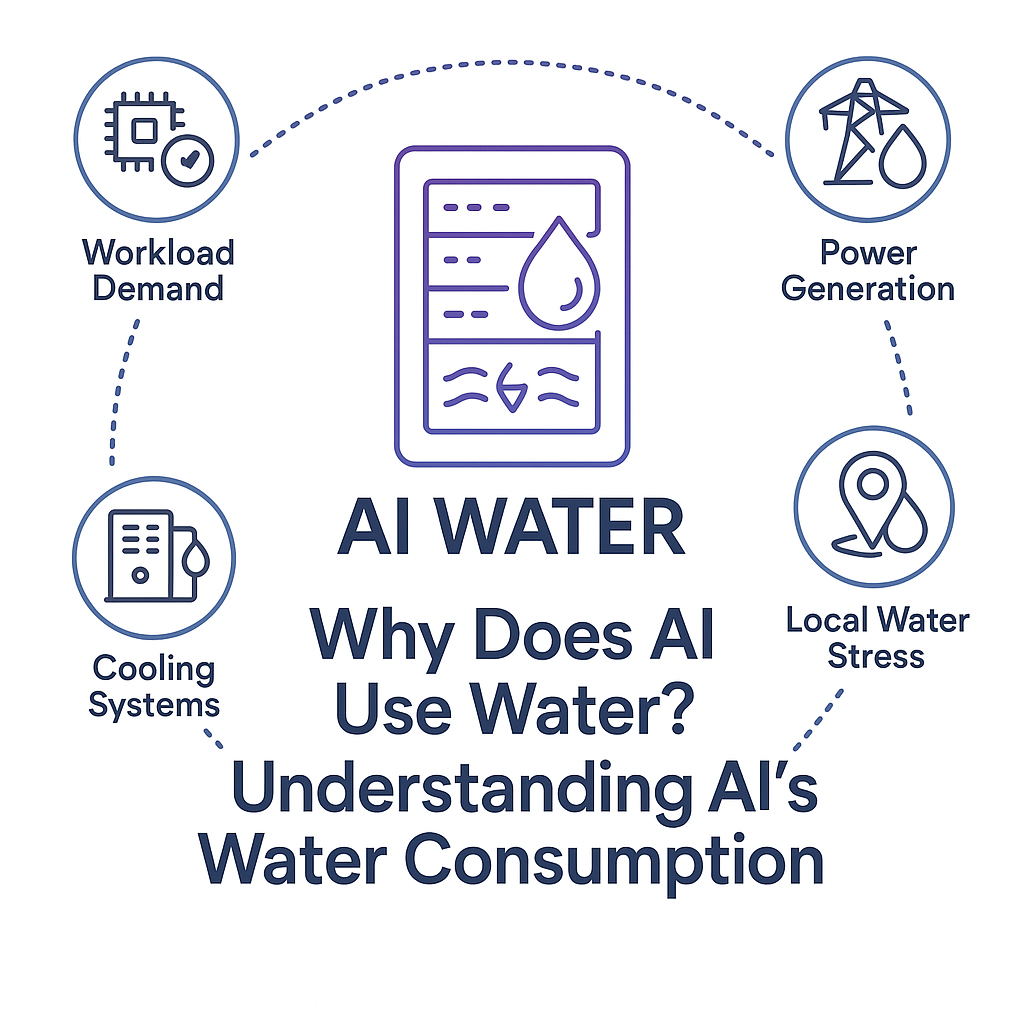
Table of Contents
Why Does AI Use Water? Understanding AI's Water Consumption
AI uses water primarily to manage heat from the computers running it, but cooling is only part of its water footprint. Here’s how water moves through data centers and why the impact varies by location and workload.
Introduction
AI uses water mainly to remove heat from the servers and GPU chips that run AI models. Some data centers use cooling systems that evaporate water to carry heat away; others circulate water in systems that consume far less on-site. AI has an indirect water footprint, too: generating electricity and manufacturing hardware can require water beyond the data center.
That distinction matters when someone asks how much water an AI query “uses.” There is no single amount that applies everywhere. The answer depends on the facility’s cooling design, the electricity supplying it, and where the water comes from. A data center drawing freshwater in a water-stressed area raises different concerns from one using reclaimed water in a region with ample supply.
Key Findings
- Judge AI water use by its pressure on local supplies, especially when data centers draw freshwater in water-stressed areas.
- AI data centers use water to remove heat from computing equipment, not to generate answers.
- Evaporative cooling consumes water, while circulating water through a cooling system does not necessarily consume it.
- Direct-to-chip liquid cooling is not necessarily water-free because a separate system may still use evaporative cooling.
- Electricity generation and hardware manufacturing can add to AI’s water footprint beyond the data center.
- When comparing water-use claims, check whether they include indirect uses and identify where the cooling water comes from.
How AI Data Centers Use Water
AI data centers use water to carry heat away from computing equipment, but circulating water is not the same as consuming it. In an evaporative cooling system, warm water releases heat as some of it turns to vapor; the facility must replace that lost water. In direct-to-chip cooling, liquid flows through sealed channels near hot GPU chips, then transfers the heat to another system. That second system may still use evaporative cooling, so a liquid-cooled server is not necessarily a water-free one. A data center’s reported water use also may not distinguish AI workloads from other computing, and it may exclude water used to generate the electricity the facility consumes.
When AI Water Use Matters Most
AI water use matters most when a data center draws freshwater from a water-stressed area, especially during hot or dry periods when other users need it too. The same volume consumed in a water-abundant location may put less pressure on local supplies, so a global total alone cannot show the local environmental impact. Data center water reuse, such as cooling with treated wastewater instead of drinking-quality water, can ease that pressure, though it does not eliminate water consumption. To assess an AI water footprint, look at the source of cooling water and when it is used, as well as water associated with electricity generation and hardware manufacturing; a cooling method that reduces on-site water use may increase electricity demand elsewhere.
Conclusion
AI does not use water to generate an answer; the infrastructure running the model uses water to manage heat, while electricity generation and hardware production can add to its wider water footprint. The impact depends on whether AI cooling systems evaporate water, recirculate it, or discharge it, and on where that water comes from. When comparing claims about AI water consumption, check whether they count only water consumed at the data center or include those indirect uses. Then look at local water conditions: water-aware data centers should be judged not just by how much water they use, but by the pressure they place on nearby supplies.
Frequently Asked Questions
Why do AI data centers need water for cooling?
AI data centers may use water to remove heat produced by servers and GPU chips as they process AI workloads. Water carries heat away efficiently, helping keep equipment within safe operating temperatures. Cooling designs vary, though: some facilities rely more on air cooling, while others use water in evaporative or liquid-cooling systems.
How much water does AI use per day or per month?
There is no single reliable daily or monthly water-use figure for AI as a whole. An estimate needs to define which data centers and workloads it covers, when use was measured, and how those facilities are cooled. It also needs to say whether it counts only water used on-site or indirect water use associated with generating electricity.
Why is ChatGPT sometimes described as wasting water?
ChatGPT is sometimes described that way because the data centers running it may use water for cooling, and generating their electricity may also involve water use. But “wasting” can obscure what is being measured. Water use per prompt is not a fixed quantity; estimates depend on the equipment, location, cooling method, and accounting assumptions.
Why can't AI data centers simply use ocean water?
Ocean water can support cooling in some locations, but it is not a straightforward replacement for freshwater. Saltwater can corrode equipment and cause mineral deposits or biological buildup, so it requires suitable systems and maintenance. Many data centers are also far from the coast, making seawater-based cooling impractical for them.
Where does water go after cooling an AI data center?
It depends on the cooling system. In evaporative cooling, some water turns to vapor as it releases heat. In closed-loop systems, water circulates repeatedly rather than being used once. Other water may be treated and reused or discharged under applicable requirements, depending on the facility’s design.
Is AI bad for the environment in 2026?
AI can have environmental impacts in 2026 because running and building its infrastructure requires electricity, water, and hardware. The size and nature of those impacts vary by facility and workload. Meaningful assessment considers local water stress, the source of electricity, cooling design, and the materials and energy used to produce equipment.
Related Articles

Best Alternatives to Jasper.ai
Discover the top AI writing tools that compete with Jasper.ai in pricing, features, usability, and content quality.

Top 10 AI Tools for Brand Reputation Management
Discover the top 10 AI tools for brand reputation management in 2025, including Brandwatch, Mention, Reputology, and more. Learn how AI-powered sentiment analysis, predictive analytics, and real-time monitoring safeguard your online presence and boost trust.

Top 10 AI Tools for Grammar Checking
Discover the top 10 AI grammar checkers in 2025: Grammarly, ProWritingAid, QuillBot, LanguageTool, Ginger, Wordtune, Hemingway, Sapling, Trinka AI, and Writer.com. Enhance clarity, style, and professionalism in your writing.